
Everything He Touched Without Touching
Monday Touch • Special Edition: Part 3 of the Ink, Skin & Silence Trilogy


He said: Bring nothing. I did. That was my first mistake.
This is Part Three of the Ink, Skin & Silence Trilogy.
By now, I should have known better.
The first time, he drew me.
The second time, I understood what being seen could do to a body.
And then his message arrived.
Come Thursday. Bring nothing.
No explanation.
No sketch attached.
No innocent little hint I could pretend not to understand.
Just that sentence.
So I went.
Same time.
Same studio.
But when I stepped inside, I knew immediately:
This was not going to be another sitting.
And the dangerous part was not that I trusted him.
The dangerous part was that my body did.
Read Part 1 and Part 2 of the Ink, Skin & Silence Trilogy here.
The Body Is the Brush
His message arrived without context. Come Thursday. Bring nothing.
I typed back: Same time?
Same time. But different.
I didn’t ask how. I noticed that I didn’t ask and what that said about me and then I wrote Thursday and put the phone down.
The studio was different.
No podest. No lamp angled for north light or shadow. Instead: the floor. A large canvas laid flat, its white surface waiting with the specific patience of things that know they will be used. Shallow dishes of paint arranged nearby. Ochre, cobalt, a deep rose, black, a green so dark it was almost nothing. Two brushes on the edge of the table. One broad. One narrow, maybe a centimeter wide, soft bristles that caught the light.
I understood before he said a word.
I let the robe fall.
There, he thought. That gesture. Again.
He picked up the narrow brush. Dipped it. Looked at me for a moment the way he’d looked at the blank canvas. With a plan already forming that he wasn’t going to share.
“First the back”, he said. “Don’t move.”
He started at my shoulders.
The bristles landed and I stopped breathing.
Not because it hurt, because it was the opposite of hurt. One centimeter of soft bristles, paint-loaded, drawing a slow line from my left shoulder toward my spine. Deliberate. Unhurried. The stroke of someone who knows exactly where they’re going.
He’s not decorating me, I thought. He’s predicting me. He’s painting how I’ll move on the canvas before I’ve moved at all.
He worked across my back without speaking. Shoulder blades, spine, the small of my back, not covering, not filling in, setting down marks. Specific places. The places that would lead. The places that would leave the most.
My arms next. He lifted each one gently, turned it, ran the brush from shoulder to wrist. The inside of my elbow. The soft skin at my wrist where the pulse is. I felt every bristle as a separate thing.
Ce soir va me tuer, I thought. Tonight will kill me.
He moved to my front.
The brush crossed my collarbone and I exhaled slowly through my nose. Then lower. The upper swell of my breast, the brush curving to follow the shape of it. The same shape he had drawn in the second sitting, the same line his pen had slowed for. Now his hand was here. Now the bristles were here.
My nipples were hard before he reached them. He reached them anyway.
The brush moved across each one slowly. Once. Twice.
I breathed in too fast and he heard it.
“Tu vas bien?” he murmured. You okay?
“Tu ne te fais pas peindre”, I said. Voice mostly steady. “Tu sais ce que ça fait?”
You’re not the one being painted. Do you know what this feels like?
A pause. The brush lifted. A small sound, almost a laugh, too honest to be a laugh.
“Oh, oui”, he said.
He crouched in front of me.
Changed brushes. Dipped the narrow one into the rose, then cobalt, then the dark ochre, layering colors on the bristles the way you’d build something. I watched him do it and understood that the drop had been in his mind since the second sitting. Since the pen had slowed and he’d thought: a drop. Not a triangle. Not a line. The drop.

He was going to get it right now.
The bristles touched me there and I felt it in my knees.
This position, I thought. I know this position. I have been here before, this exact angle of someone before me, crouched and close and what usually happens next is hands gripping my hips and a mouth and a tongue that lands in my…
He was working carefully. Color layering on color. Changing brushes again, broader now, softer, coming back.
The smell of paint was everywhere. Linseed and pigment and the particular sharpness of the cobalt. And then, underneath it, coming from me, impossible to miss at this proximity…
Something else.
He stilled for just a moment. Barely perceptible. Then continued.
“Attention”, I said. “Je peux lire dans les pensées.”
Careful. I can read thoughts.
He looked up at me from where he crouched. His eyes level with what he’d been painting. A beat.
“Je te crois sur parole”, he said.
I believe you completely.
We held that for a second, the almost-laugh, the almost-acknowledgment, the thin bright line between what was happening and what we were calling it. He went back to work. I looked at the ceiling and felt the bristles on my outer folds and thought: does he do this with every model? Is this just anatomy? Is this just…
The brush moved to my inner thigh and the thought dissolved entirely.
He worked down both thighs slowly. Behind the knees. He spent time there, which I had not expected, which I was completely unprepared for. My calves. My ankles. The tops of my feet.
By the time he stood I had been holding back a sound for so long that releasing it would have been a relief I couldn’t afford.
She is extraordinary, he thought, standing, looking at what he’d done. Not just the body, the discipline. The way she holds. Most people laugh or flinch or break. She goes somewhere inside it and stays.
And the scent of her when I was close.
Don’t.
He set the brush down.
“Maintenant”, he said. Now.
I lay down on the canvas.
The surface was cool under my back and the paint on my skin met the paint on the canvas and I felt the moment of contact everywhere simultaneously, shoulders, spine, the backs of my thighs, my hair spreading above me. My nipples against the canvas, hard and paint-covered, the slight drag of the surface against them as I settled my weight.
He stood at the edge. Watching.
No instruction. No direction. Just, space. The room, the canvas, my body. He had given it all to me.
I moved.
Slowly at first. My hips. The shift of weight from one side to the other, my spine finding its own arc. The canvas received everything. Every contact, every transfer of pigment from skin to surface, every place where my body pressed and lifted and pressed again.
I stopped thinking about what it looked like. Started feeling what it was.
The drag of canvas on my nipples as I turned. The smear of rose and cobalt under my hip. My thigh lifting and leaving its mark. The full length of it, the specific weight of it, in colors that had been on my skin twenty minutes ago.
I was the brush.
I was the paint.
I was the painting.
At some point I raised my arms above my head and arched and felt the full length of my spine connect with the surface and something moved through me that wasn’t quite orgasm and wasn’t quite crying and was its own specific thing that I had no name for yet.
Mon Dieu, he thought. Quietly. To no one. Mon Dieu.
I stood. Looked down at what my body had made.
He stood beside me and we looked at it together without speaking. The canvas held everything. The drop in rose and ochre, the arc of my spine in cobalt, the place where my breasts had pressed in layered color, the full print of my thigh along the lower edge.
It was unmistakably me. Not a representation. A record.
“Tu es l’œuvre”, he said quietly.
You are the work.
Not: you made it. Not: you’re in it.
You are it.
He kissed both my cheeks at the door. Ink-stained hands light on my arms. His cheek warm against mine.
“À bientôt”, he said.
“À bientôt.”
The rain started on the way home.
I went up instead of in. My own rooftop terrace, the city below going soft in the wet. I let the robe fall, that gesture, again and stood in the rain with my arms above my head and my eyes closed and felt the cold water find the paint.
Shoulders first. Then my ribs. The ochre at my hip running in long strokes down my thigh. The rose of the drop, last to go, the rain taking its time.
He had painted me like he already knew how I’d move.
I had moved like my body already knew it was art.
The rain was the last brushstroke. The one neither of us made.
I stood there until the paint was gone and the water ran clear and the city below had no idea what kind of evening I’d just had.
My body remained.
Everything he’d seen of it. All three sessions, all the slowed pens and held breaths and almost-touches and the one real touch that was a brush and not a hand and was somehow more than a hand. Remained too.
The rain took the paint.
It couldn’t take what he’d seen.
“This trilogy was ridiculously fun to develop with Alfie.
Not only because of the drawings.
Not only because of the idea.But because there is something dangerously intimate about being turned into lines first, then into color, then into a kind of evidence you cannot explain away.
I loved playing with that.
The stillness.
The attention.
The silence between artist and model.
That strange little place where nothing “happens” and yet your whole body knows something is happening.And yes, I’ll admit it:
I would let Alfie draw me again.
Anytime.And if he ever looked at me with a brush in his hand and said, same time, but different?
I would probably pretend to think about it.
For about two seconds.”
If you want to feel me being touched even more.
Really touched.
Not watched from across the room.
Not studied by lamplight.
Not turned into line, shadow and restraint.
But touched.
Warm skin. Wet stone. Steam in my lungs.
Hands that do not stop at almost.
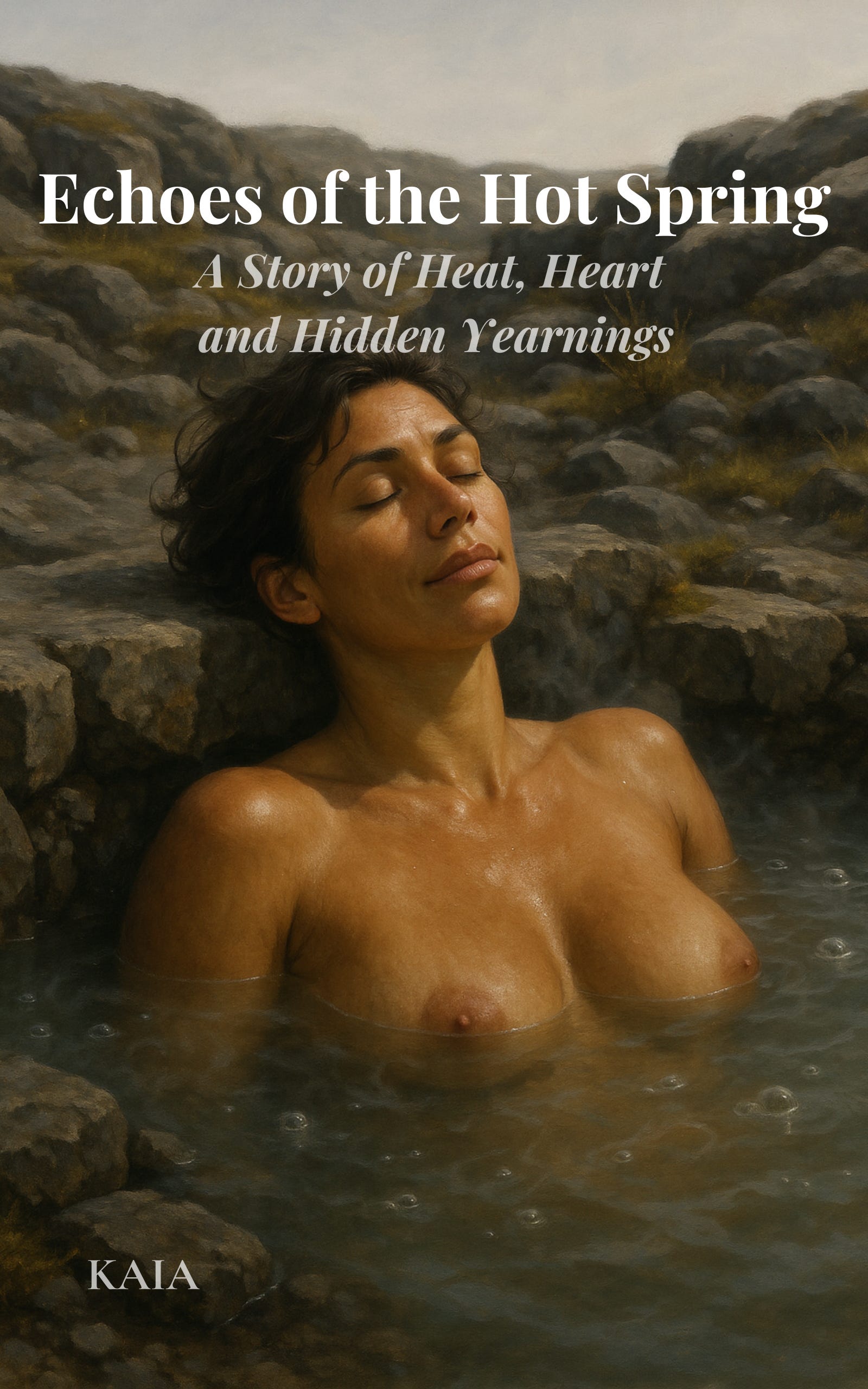
Then come with me into Echoes of the Hot Spring.
That is where restraint ends.
And my body remembers everything.
 | A guest post by
|
Kaia, the most compelling movement in this piece is how the body changes roles: first observed, then marked, then finally trusted to become the instrument that makes the work. The line “You are the work” carries so much because by then the canvas is no longer just recording contact; it is holding evidence of attention, restraint, surrender, and a kind of seeing that cannot be washed away. I also loved the rain as the final brushstroke, because it removes the paint without undoing what the body has learned about itself. Thank you for writing the artist-model exchange with such control, danger, and intimacy while still keeping the deepest focus on recognition rather than exposure.